
Outer Functionalization CNTs

April 10, 2024 – Single-walled carbon nanotubes (SWCNTs) are hard to functionalize in a robust way without damaging their carbon lattice. Researchers from Ulm University and Friedrich-Alexander-Universität Erlangen-Nürnberg have now closed positively charged macrocycles around the nanotubes in water and found that, at the same time, the triiodide counterions of the rings slip into the tubes and form polyiodide chains. The result is a three-shell composite with rings outside and chains of iodine inside that leaves the properties of the nanotubes almost untouched and could be of interest for energy storage.
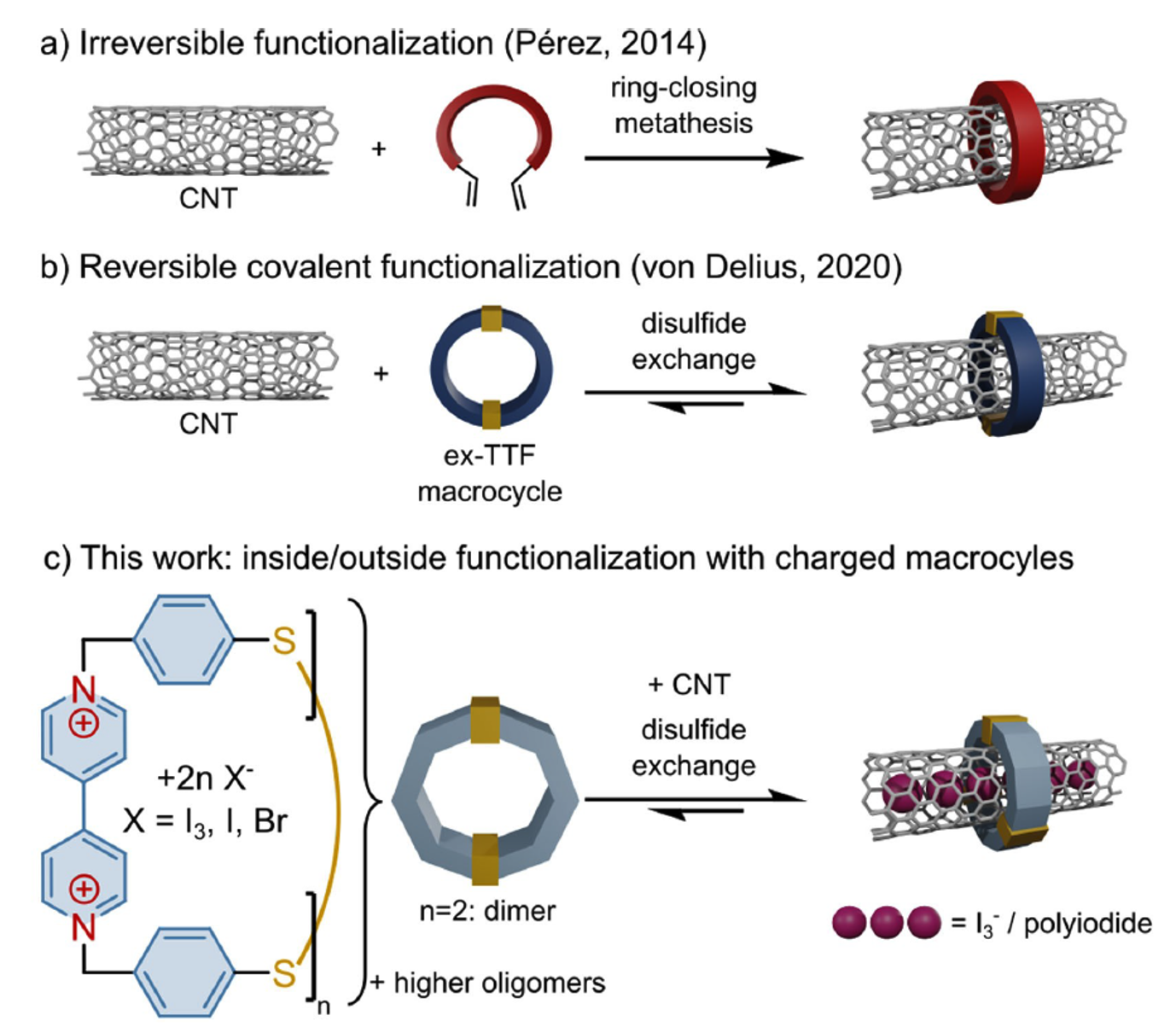
To make single-walled carbon nanotubes (SWCNTs) processable from solution, chemists can attach groups to them covalently.1,2 This partly destroys the sp2 carbon lattice and thus changes the optoelectronic properties of the tubes. The alternative is non-covalent: the weak binding of supramolecular motifs,3 the wrapping of (bio)polymers4 or of detergents5 around the nanotubes. In 2014, Pérez and co-workers added a third way, discrete rings closed around the tube (Fig. 1a).6 Over the past decade, Pérez and others have expanded the scope and the applications of such mechanically interlocked nanotubes (MINTs),7–10 and the Ulm group has shown that disulfide exchange,11–13 a reversible ring-closing reaction, forms MINTs in organic solvents (Fig. 1b).14 The study is described in the news article Disulfide Rings on Nanotubes.
Filling the Tube
The hollow interior of a nanotube can be functionalized as well. The best-known examples are the “fullerene peapods”, nanotubes of relatively large diameter filled with fullerenes. Dyes15 and smaller atomic guests have also been encapsulated, among them sulfur, iodine, alkali metals and even krypton.16 These small-diameter peapods have potentially useful properties, for instance as photocatalysts for CO2 reduction, as electrically conducting materials17,18 and as contrast agents in biological imaging.16
The team has now done both at once. Treating pristine SWCNTs with positively charged macrocycles that contain viologen units, disulfide bonds and triiodide counteranions wrapped rings around the nanotubes by dynamic covalent exchange and, unexpectedly, also filled the tubes with polyiodide chains (Fig. 1c). The new macrocycle was designed for water solubility, easy synthesis and high rigidity. The authors reasoned that in water, the hydrophobic effect and van der Waals dispersion would be the dominant driving force for the rings to associate with the nanotubes.19
Rings From Simple Building Blocks
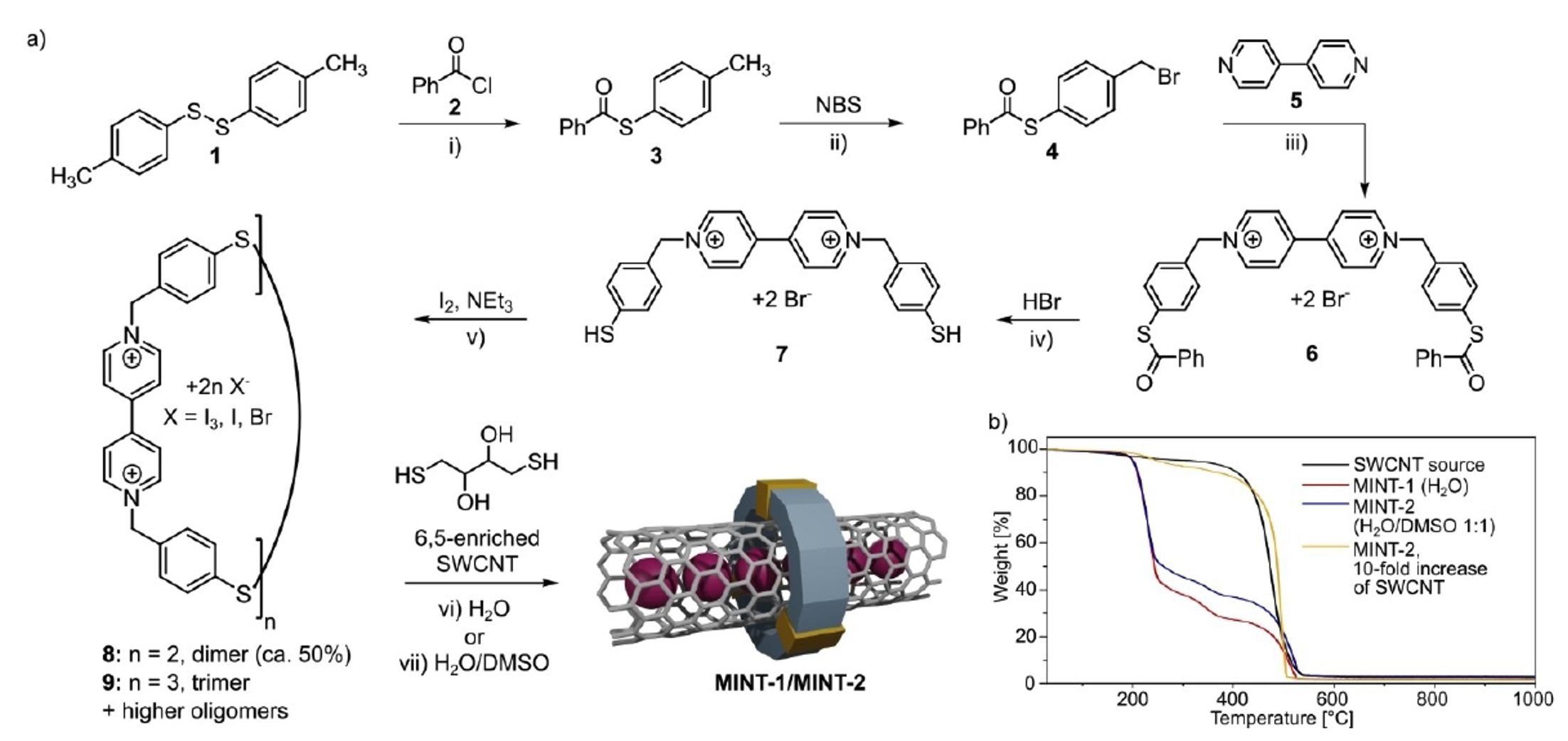
The key macrocycle was prepared in a concise synthesis from simple starting materials (1, 2, 5) as a mixture of the dimer 8, the main product with about 50 %, the trimer 9 and higher oligomers (Fig. 2a). The final ring closure proceeded in quantitative yield. Oxidation with an excess of iodine (6 eq.) in chloroform under basic conditions gave triiodide as the dominant counteranion. The authors did not notice this at first, but it became important during the functionalization. The macrocycle mixture was then treated with the mild reductant dithiothreitol in basic aqueous medium in the presence of (6,5)-enriched SWCNTs, in the same way as in the group’s earlier work with ex-TTF disulfide macrocycles,14 except for the solvent. One batch was made in pure water set to pH 9.0 (MINT-1), the other in a 1:1 mixture of water at pH 9.0 and DMSO (MINT-2), each for 7 days at room temperature. The solids were filtered off, washed with methanol under ultrasonication and dried under vacuum.
Thermogravimetric analysis (TGA) of both products showed a pronounced drop in mass starting at 190–200 °C, whereas the source nanotubes only lost mass from 400–410 °C on (Fig. 2b). The team therefore attributed the loss between 200 and 400 °C to the macrocycles: 73 % of the total mass for MINT-1 and 62 % for MINT-2, a relatively high degree of functionalization, which also showed in the mass gain of the products even after thorough washing. MINT-1 and MINT-2 were prepared with about 10 % wt/wt of SWCNTs relative to the macrocycle mixture. A separate batch of MINT-2 with 100 % wt/wt, a tenfold higher share of nanotubes, gave qualitatively the same kind of TGA curve, only with less mass lost between 200 and 400 °C (yellow curve in Fig. 2b).
A Ring Around a Single Tube
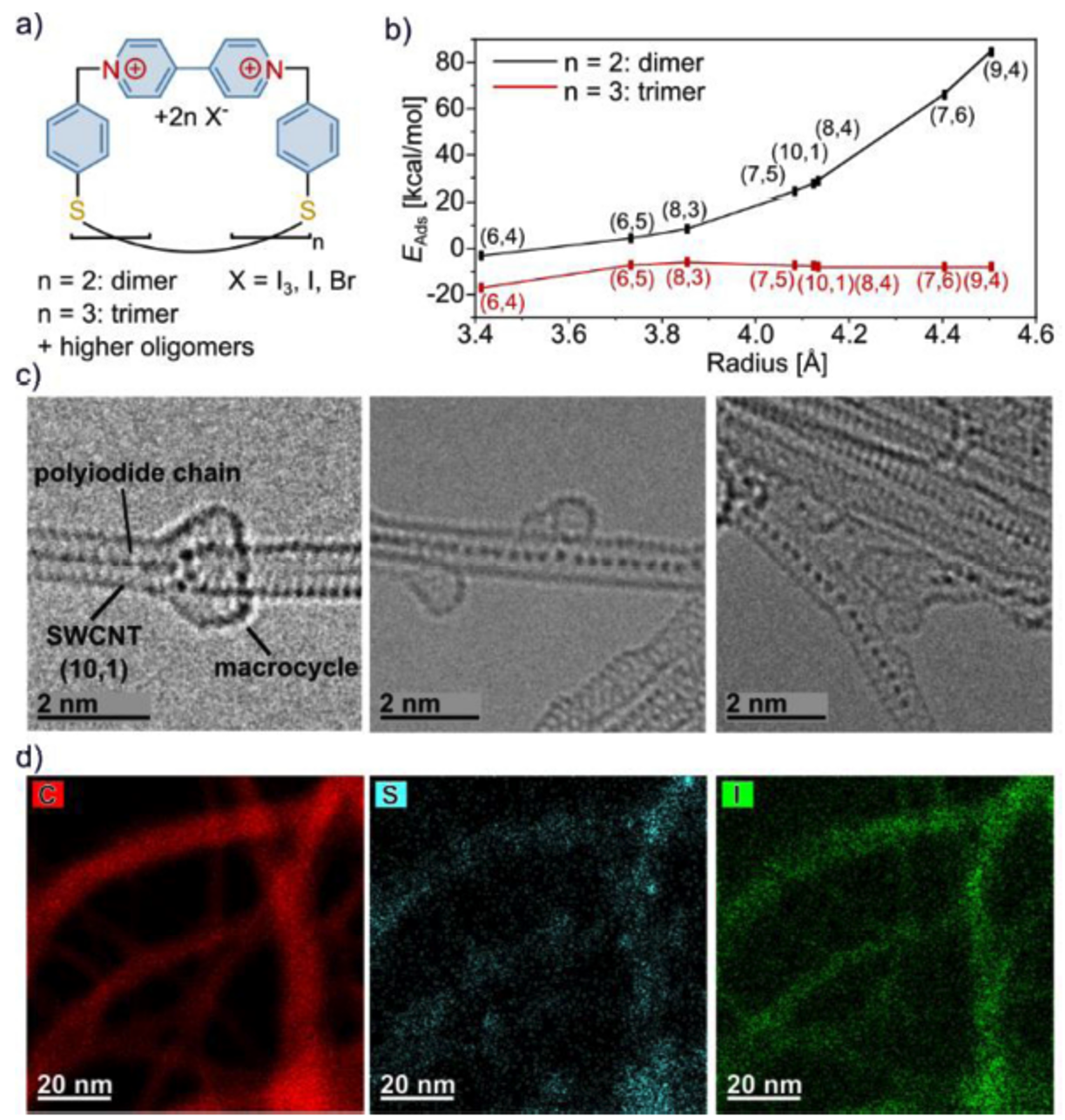
To learn how the new composite is built, the Ulm group imaged it by aberration-corrected high-resolution transmission electron microscopy (AC-HRTEM) at 80 kV and mapped its elements by energy-dispersive X-ray spectroscopy (EDX). Sections of MINT-2 and MINT-1 show individualized nanotubes besides the typical bundles (Fig. 3c, centre and right). A zoomed-in view of MINT-2 shows an isolated nanotube with a structure around it that resembles a macrocycle (Fig. 3c, left). The authors tentatively proposed that this ring is a trimer: its shape is triangular, and the calculations for the (10,1) chirality of this particular tube indicate a better size match with the trimer than with the dimer (Fig. 3b).
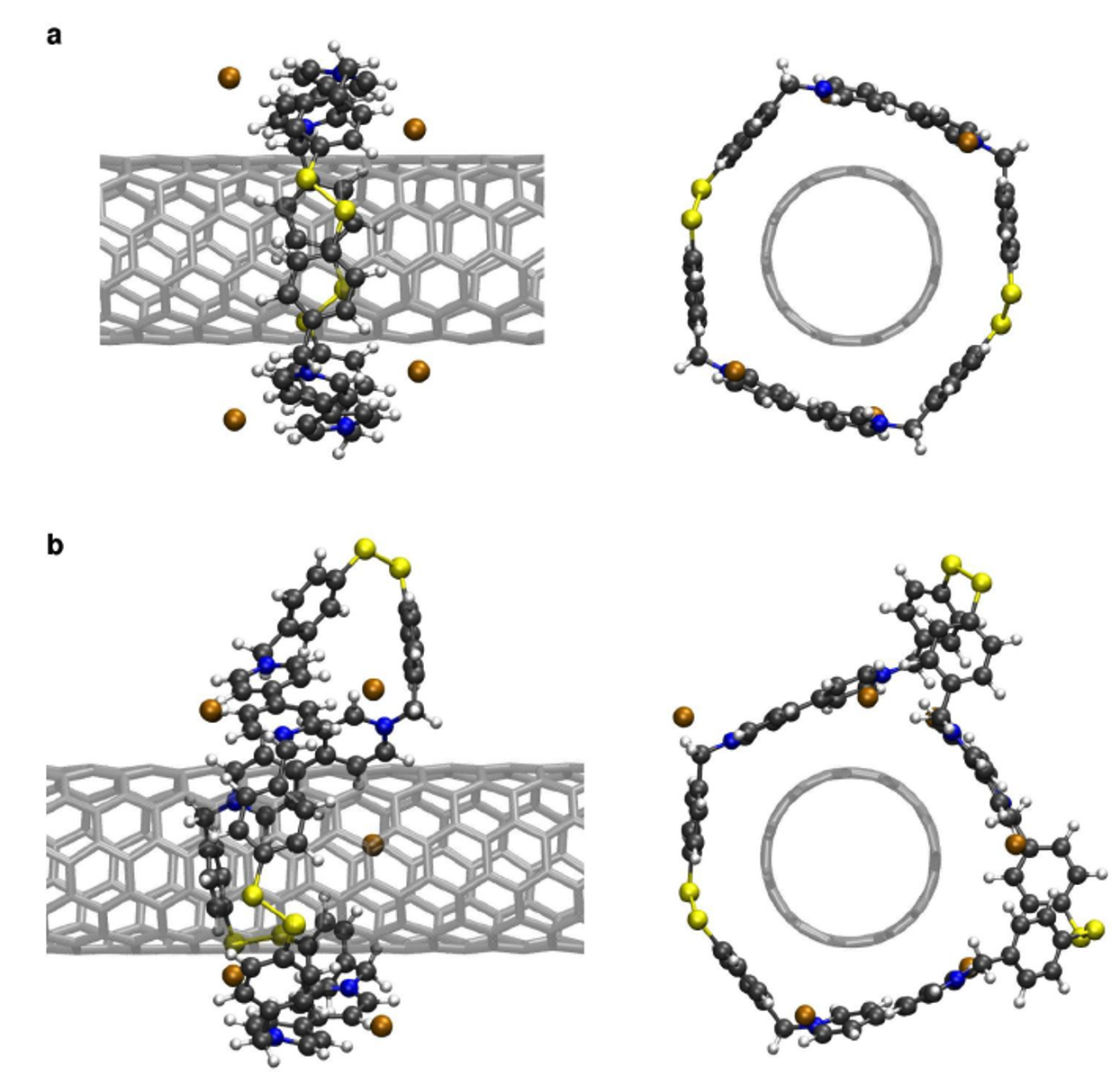
These calculations used the generalized Amber force field to compute adsorption energies of dimeric and trimeric macrocycles with bromide counterions on nanotubes with radii from 3.41 to 4.50 Å, from (6,4) to (9,4) tubes (Figs. 3a, b). Because the flexible rings have many local energy minima, each structure was found by a molecular dynamics search: heating to 700 K, a production run of 5 ns and 500 relaxed snapshots, of which the one with the lowest energy was kept. Dispersion between ring and tube gives negative adsorption energies as long as the ring is unstrained, roughly in proportion to the ring size. When the tube becomes too thick, strain builds up in the ring and the adsorption energy turns positive, as Fig. 3b shows for the dimer. Even around the thin (6,5) tube the dimer sits rather tight (Fig. 4a), though still unstrained, and a small increase in diameter is enough to induce significant strain. The trimer, in contrast, wraps loosely around all tubes studied, visible in small loops within the ring (Fig. 4b). Dimers are therefore expected only around the thinnest nanotubes, while thicker tubes carry rings of three units.
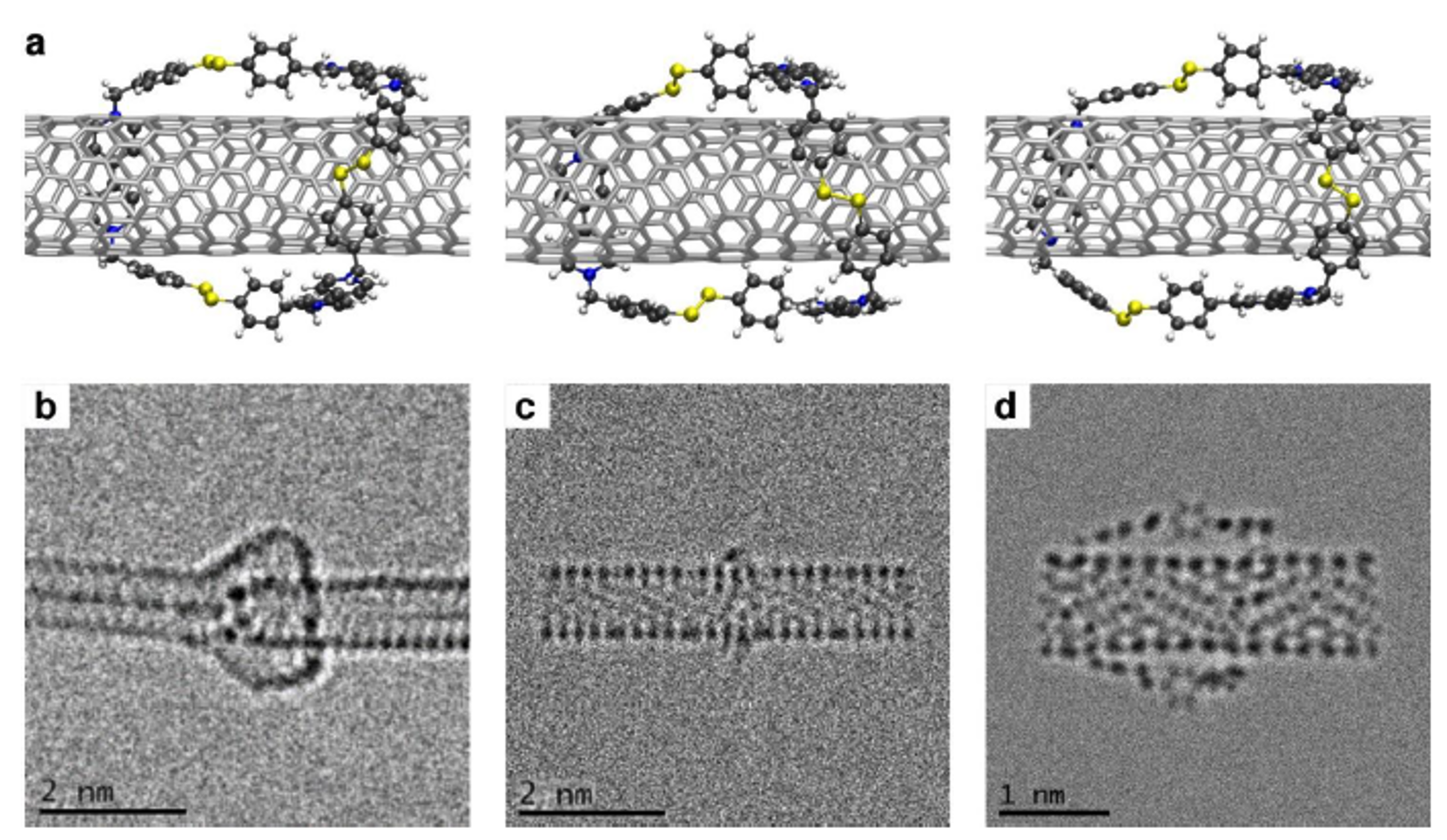
Around the (10,1) tube, the trimer takes a tilted, triangular shape (Fig. 5a). The search produced many such rings that closely resemble the HRTEM image; three of them are shown next to it, together with simulated HRTEM images of a dimer and a trimer around a (10,1) tube (Figs. 5b–d). Interestingly, all three HRTEM images also show chains of single atoms inside the nanotubes. STEM-EDX maps of MINT-1 located carbon, sulfur and iodine (Fig. 3d). The carbon map matches the HAADF-STEM and bright-field images, as expected, since carbon dominates both the nanotubes and the macrocycles. Sulfur is spread more unevenly but still follows the carbon, which fits disulfide rings wrapped around the tubes. The same holds for the substantial amount of iodine, which could come either from encapsulated polyiodide chains or from counteranions bound outside.
What the Chains Are Made Of
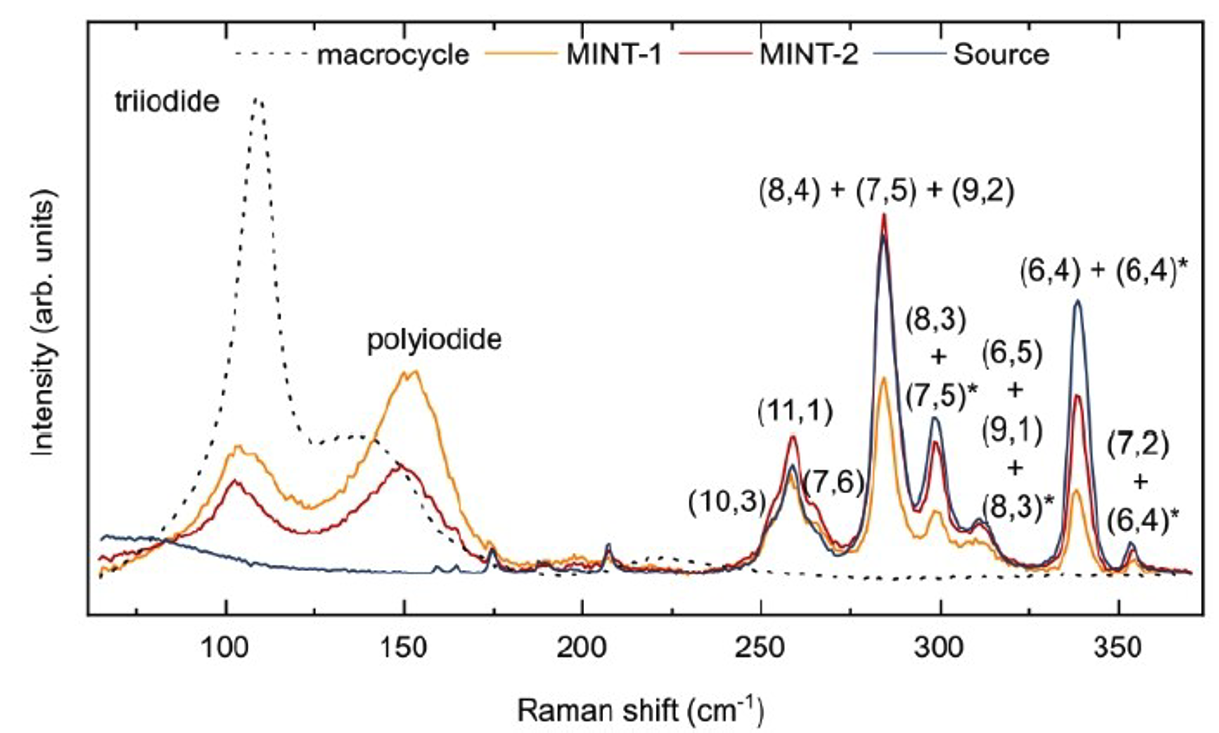
To find out what the atomic chains are, the Erlangen group recorded Raman spectra with a 633 nm laser on bundles of nanotubes drop-cast from methanol onto a Si/SiO2 wafer. The diameter-dependent radial breathing modes (RBMs) and their chiral indices are shown in Fig. 6; double-walled tubes were found as well, their inner tubes marked with a star, while the RBMs of outer tubes lie between 150 and 210 cm−1. The spectrum of the pure macrocycles without nanotubes (dotted line) has its dominant bands at about 110, 150 and 225 cm−1, and only weak bands between 1000 and 2000 cm−1. The team attributed the dominant bands to triiodide chains, in good agreement with the Raman spectra of iodide chains in the literature.20 In MINT-1 and MINT-2 these low-frequency modes differ from the macrocycle sample. The triiodide mode at about 110 cm−1 is slightly downshifted, because triiodide chains are easily deformed. The strong intensity of the peak around 150 cm−1 and its upshift point to longer polyiodide chains inside the nanotubes,21 and such chains can also contribute to the downshift of the 110 cm−1 band, as some of them have weak modes around 100 cm−1.21 The intense polyiodide signal, the authors wrote, “represents strong evidence for endohedral functionalization”, as also seen in the HRTEM images (Fig. 3c). The weak macrocycle modes between 1000 and 2000 cm−1 are probably hidden under the nanotube bands in the same range.
Almost Unchanged Nanotubes
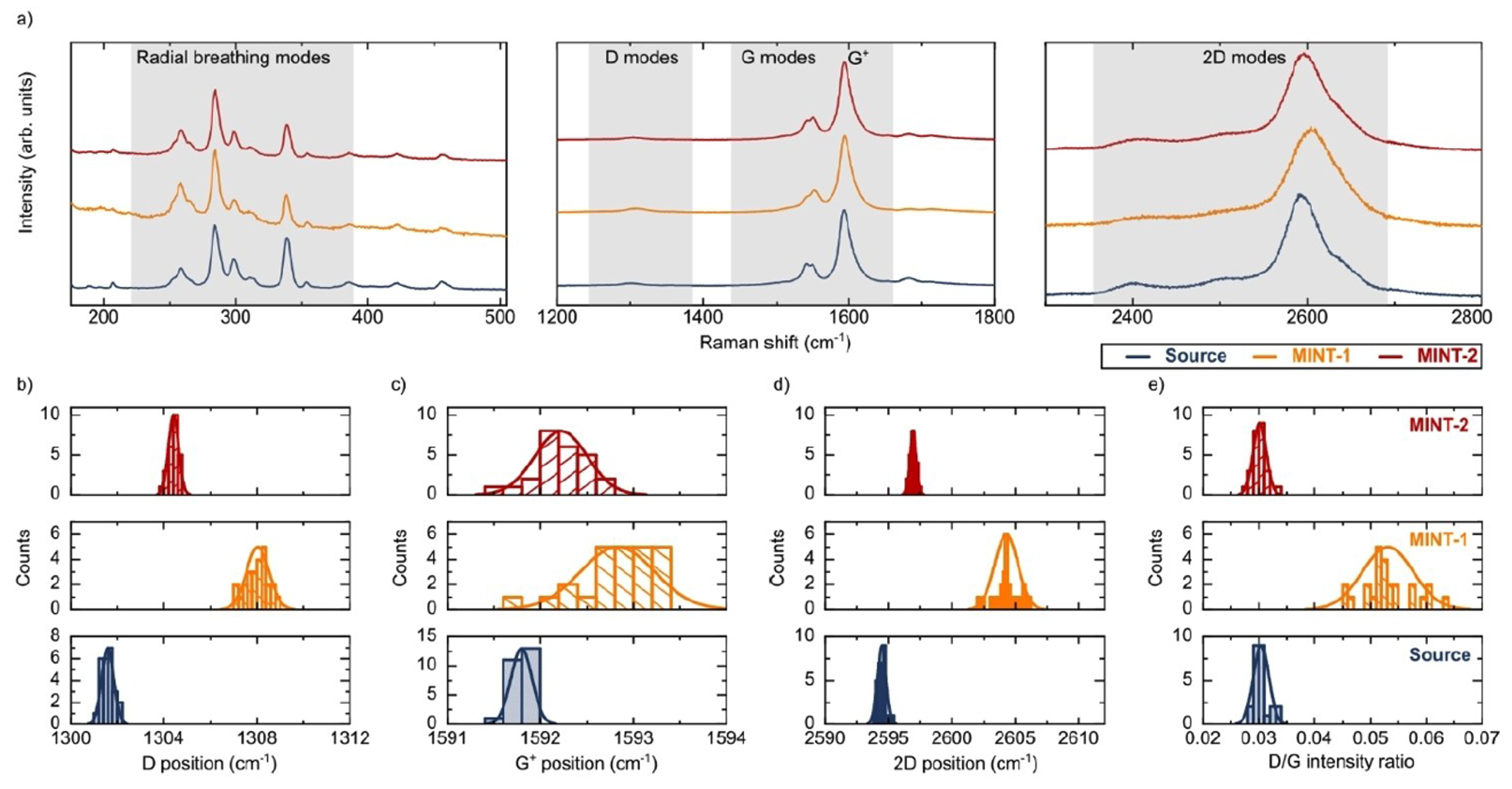
How does the simultaneous functionalization from inside and outside affect the nanotubes? The pattern and the frequencies of the RBMs in Fig. 6 do not change significantly after functionalization, so the reaction is not diameter-selective, in contrast to earlier macrocycle–nanotube systems.6–8,14 The authors gave two reasons: water produces a stronger solvophobic effect than the tetrachloroethane6 or DMSO14 of earlier MINT preparations, and the polyiodide chains inside likely add a driving force for rings to close around tubes of different diameters, even when ring and tube do not match in size. Representative spectra of the source material, MINT-1 and MINT-2 have the same overall shape, showing that the nanotube lattice stays intact (Fig. 7a), with the typical Raman modes of single-walled nanotubes.22 The G+, D and 2D modes of the functionalized tubes are slightly upshifted (Figs. 7b–d), a sign of weak charge transfer, which is possible between all components: nanotubes, macrocycles and polyiodide chains.
Functionalization affected MINT-1 more than MINT-2 (Fig. 7). The D/G intensity ratio reveals an increased defect concentration in MINT-1, whereas the source material and MINT-2 have similar defect concentrations, as expected for non-covalent binding (Fig. 7e). Pure water thus seems to introduce some additional defects into the nanotubes, while the water/DMSO mixture is preferable when a material low in defects is wanted. The authors suggested that DMSO improves the kinetics of thiol/disulfide exchange, as Alfonso has reported. Photoluminescence excitation spectroscopy of the untreated tubes, MINT-1 and MINT-2 confirmed this picture: the signals are not significantly affected by the functionalization and show no diameter selectivity, in line with the RBM spectra.
Three Shells, One Material
The new material consists of three shells: polyiodide chains inside, the carbon nanotube and a ring of macrocycles outside. “This double functionalization works, because dynamic covalent disulfide exchange leads to the self-assembly of the macrocycles around the nanotube template, while the triiodide counterions of the macrocycles form polyiodide chains in the hollow inside space of the carbon nanotubes,” the authors conclude. Since Raman and photoluminescence show little effect on the fundamental properties of the nanotubes, the study extends the growing class of dynamic covalent materials.23–27 The composite is redox-active and experiences, in the words of the authors, “an intriguing interplay of electrostatic, solvophobic and mechanical effects that could be of interest for applications in energy storage”. Exploring these functional properties is the team’s next step.
Resource:
Kraus, J., Meingast, L., Hald, J., Beil, S. B., Biskupek, J., Ritterhoff, C. L., Gsänger, S., Eisenkolb, J., Meyer, B., Kaiser, U., Maultzsch, J., & von Delius, M. (2024).
Simultaneous inside and outside functionalization of single-walled carbon nanotubes.
Angewandte Chemie International Edition, 63(20), e202402417.
https://doi.org/10.1002/anie.202402417
 Download this news article as PDF – for reading on paper, taking notes or filing.
-
Bianco, A., & Prato, M. (2003). Can Carbon Nanotubes be Considered Useful Tools for Biological Applications?. Advanced Materials, 15, 1765–1768. https://doi.org/10.1002/adma.200301646
-
Norizan, M. N., Moklis, M. H., Ngah Demon, S. Z., et al. (2020). Carbon nanotubes: functionalisation and their application in chemical sensors. RSC Advances, 10, 43704–43732. https://doi.org/10.1039/D0RA09438B
-
Romero-Nieto, C., García, R., Herranz, M. Á., et al. (2012). Tetrathiafulvalene-Based Nanotweezers—Noncovalent Binding of Carbon Nanotubes in Aqueous Media with Charge Transfer Implications. Journal of the American Chemical Society, 134, 9183–9192. https://doi.org/10.1021/ja211362z
-
Gao, T. Z., Sun, Z., Yan, X., Wu, H.-C., Yan, H., & Bao, Z. (2020). Engineering Supramolecular Polymer Conformation for Efficient Carbon Nanotube Sorting. Small, 16, 2000923. https://doi.org/10.1002/smll.202000923
-
Yang, F., Wang, M., Zhang, D., Yang, J., Zheng, M., & Li, Y. (2020). Chirality Pure Carbon Nanotubes: Growth, Sorting, and Characterization. Chemical Reviews, 120, 2693–2758. https://doi.org/10.1021/acs.chemrev.9b00835
-
de Juan, A., Pouillon, Y., Ruiz‐González, L., et al. (2014). Mechanically Interlocked Single‐Wall Carbon Nanotubes. Angewandte Chemie International Edition, 53, 5394–5400. https://doi.org/10.1002/anie.201402258
-
Martínez-Periñán, E., de Juan, A., Pouillon, Y., et al. (2016). The mechanical bond on carbon nanotubes: diameter-selective functionalization and effects on physical properties. Nanoscale, 8, 9254–9264. https://doi.org/10.1039/C6NR01182A
-
Miki, K., Saiki, K., Umeyama, T., et al. (2018). Unique Tube–Ring Interactions: Complexation of Single‐Walled Carbon Nanotubes with Cycloparaphenyleneacetylenes. Small, 14, 1800720. https://doi.org/10.1002/smll.201800720
-
Pérez, E. M. (2017). Putting Rings around Carbon Nanotubes. Chemistry – A European Journal, 23, 12681–12689. https://doi.org/10.1002/chem.201702992
-
López-Moreno, A., & Pérez, E. M. (2015). Pyrene-based mechanically interlocked SWNTs. Chemical Communications, 51, 5421–5424. https://doi.org/10.1039/C4CC08970G
-
Fritze, U. F., & von Delius, M. (2016). Dynamic disulfide metathesis induced by ultrasound. Chemical Communications, 52, 6363–6366. https://doi.org/10.1039/C6CC02034H
-
Fritze, U. F., Craig, S. L., & von Delius, M. (2018). Disulfide‐centered poly(methyl acrylates): Four different stimuli to cleave a polymer. Journal of Polymer Science Part A: Polymer Chemistry, 56, 1404–1411. https://doi.org/10.1002/pola.29021
-
Black, S. P., Sanders, J. K. M., & Stefankiewicz, A. R. (2014). Disulfide exchange: exposing supramolecular reactivity through dynamic covalent chemistry. Chem. Soc. Rev., 43, 1861–1872. https://doi.org/10.1039/C3CS60326A
-
Balakrishna, B., Menon, A., Cao, K., et al. (2020). Dynamic Covalent Formation of Concave Disulfide Macrocycles Mechanically Interlocked with Single‐Walled Carbon Nanotubes. Angewandte Chemie International Edition, 59, 18774–18785. https://doi.org/10.1002/anie.202005081
-
Forel, S., Li, H., van Bezouw, S., et al. (2022). Diameter-dependent single- and double-file stacking of squaraine dye molecules inside chirality-sorted single-wall carbon nanotubes. Nanoscale, 14, 8385–8397. https://doi.org/10.1039/D2NR01630C
-
Serpell, C. J., Rutte, R. N., Geraki, K., et al. (2016). Carbon nanotubes allow capture of krypton, barium and lead for multichannel biological X-ray fluorescence imaging. Nature Communications, 7, 13118. https://doi.org/10.1038/ncomms13118
-
Zhao, Y., Wei, J., Vajtai, R., Ajayan, P. M., & Barrera, E. V. (2011). Iodine doped carbon nanotube cables exceeding specific electrical conductivity of metals. Scientific Reports, 1, 83. https://doi.org/10.1038/srep00083
-
Fujimori, T., & Urita, K. (2016). Effect of selectively intercalated polyiodide on the electric transports of metallic- and semiconducting-enriched single-wall carbon nanotube networks. Applied Physics Letters, 108, 263111. https://doi.org/10.1063/1.4955057
-
Wang, J., Chu, H., & Li, Y. (2008). Why Single-Walled Carbon Nanotubes Can Be Dispersed in Imidazolium-Based Ionic Liquids. ACS Nano, 2, 2540–2546. https://doi.org/10.1021/nn800510g
-
Johnson, A. E., & Myers, A. B. (1996). Solvent Effects in the Raman Spectra of the Triiodide Ion: Observation of Dynamic Symmetry Breaking and Solvent Degrees of Freedom. The Journal of Physical Chemistry, 100, 7778–7788. https://doi.org/10.1021/jp953052x
-
Yoshida, Y., Ishii, Y., Kato, N., Li, C., & Kawasaki, S. (2016). Low-Temperature Phase Transformation Accompanied with Charge-Transfer Reaction of Polyiodide Ions Encapsulated in Single-Walled Carbon Nanotubes. The Journal of Physical Chemistry C, 120, 20454–20461. https://doi.org/10.1021/acs.jpcc.6b07819
-
Maultzsch, J., & Thomsen, C. (2008). Characterization of carbon nanotubes by optical spectroscopy. In C. Hierold (Ed.), Carbon Nanotube Devices: Properties, Modeling, Integration and Applications (pp. 101–143). Wiley-VCH, Weinheim. https://doi.org/10.1002/9783527622597.ch4
-
Geng, K., He, T., Liu, R., et al. (2020). Covalent Organic Frameworks: Design, Synthesis, and Functions. Chemical Reviews, 120, 8814–8933. https://doi.org/10.1021/acs.chemrev.9b00550
-
Giuseppone, N. (2012). Toward Self-Constructing Materials: A Systems Chemistry Approach. Accounts of Chemical Research, 45, 2178–2188. https://doi.org/10.1021/ar2002655
-
Slater, A. G., & Cooper, A. I. (2015). Function-led design of new porous materials. Science, 348, aaa8075. https://doi.org/10.1126/science.aaa8075
-
Mastalerz, M. (2010). Shape‐Persistent Organic Cage Compounds by Dynamic Covalent Bond Formation. Angewandte Chemie International Edition, 49, 5042–5053. https://doi.org/10.1002/anie.201000443
-
Haase, F., & Lotsch, B. V. (2020). Solving the COF trilemma: towards crystalline, stable and functional covalent organic frameworks. Chemical Society Reviews, 49, 8469–8500. https://doi.org/10.1039/D0CS01027H