
Hot Carriers in 2D Polymers

May 13, 2025 – An international team from TU Dresden, the Max Planck Institute for Polymer Research, Utrecht University, Ulm University, the University of Hong Kong and further partners has shown that highly mobile 'hot carriers' exist in a two-dimensional conjugated polymer, Cu₃BHT, and reach ultrahigh mobility. The finding could accelerate the development of organic-based hot carrier devices for applications like high-speed transistors and efficient photovoltaics.
Hot carriers are high-energy electrons and holes that exist out of thermal equilibrium with the crystal lattice. Their unique properties have driven innovation in fields such as photovoltaics, transistors, photodetectors, photocatalysis and bolometers.1,2 Computational and experimental studies have outlined a general three-stage process for hot carriers: generation, thermalization and relaxation.3–5
The study of hot carriers in organic compounds, however, lags far behind that in inorganic or hybrid materials. The main reason is the extremely fast energy relaxation in conventional organic materials,6,7 compounded by dynamic disorder, strong Coulomb interactions between electron–hole pairs and intense charge–vibration coupling.3,8
The recent emergence of synthetic two-dimensional (2D) organic crystals, particularly 2D conjugated coordination polymers (2D c-CPs), opens a new avenue. These materials display attractive opto-electronic properties stemming from tunable intralayer d–π conjugation and interlayer electronic coupling.9 Advances in synthesis now allow precise control over stoichiometry, structure, layer orientation and morphology, leading to a variety of structures with diverse properties.10 A key property is their high electrical conductivity, which can reach up to 103 S cm−1.11
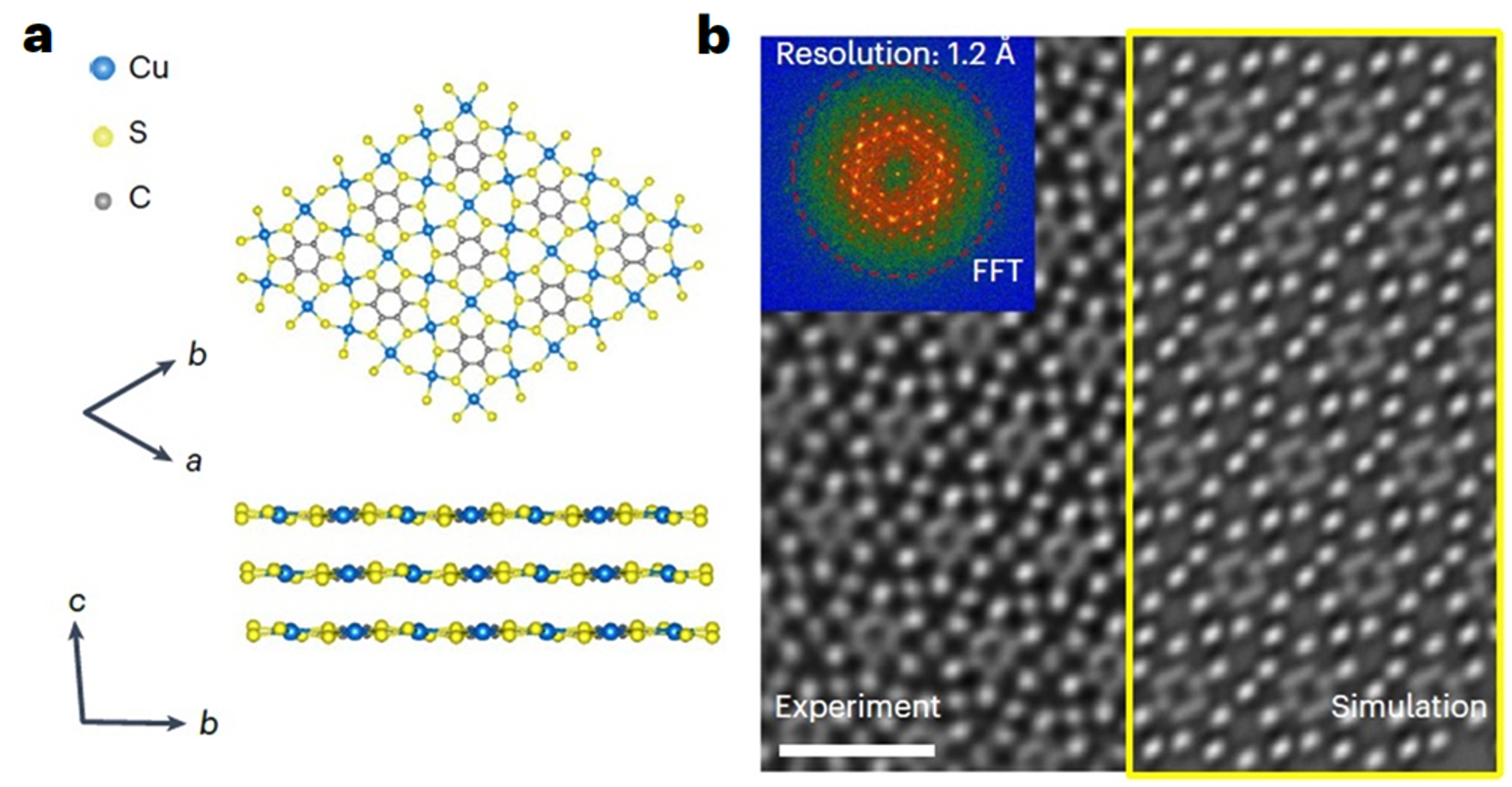
For hot carrier applications, 2D c-CPs make it possible to engineer electronic and phononic properties at the molecular level, creating high-mobility charge transport channels while slowing down the cooling of hot carriers.12 The researchers combined time-resolved terahertz spectroscopy (TRTS), transient absorption spectroscopy (TAS) and transient absorption microscopy (TAM) to follow the spatiotemporal evolution of non-equilibrium photoexcitation. With this approach they tracked how charge transport depends on the excess kinetic energy of the carriers in a model 2D c-CP system, Cu₃BHT (BHT: benzenehexathiol; Fig. 1a).
Together, these experiments give a comprehensive view of transport across temporal, spatial and frequency domains. Photoexcitation above the band gap launches a transport cascade in highly crystalline Cu₃BHT films. In this non-equilibrium state, hot carriers dominate: they show an exceptionally high charge mobility of about 2,000 cm² V⁻¹ s⁻¹ and travel up to about 300 nm, across grain boundaries.
The cooling of these highly mobile hot carriers is relatively slow, taking up to about 750 fs. This is due to the material's low optical phonon energy and small electron–hole reduced effective mass, and it makes Cu₃BHT comparable to state-of-the-art lead-halide perovskites, which are known to suit hot carrier applications.13 Once the carriers have cooled and reached a quasi-equilibrium state, these band-edge carriers show band-like, Drude-type free carrier transport, with a charge mobility of about 400 cm² V⁻¹ s⁻¹ and an intrinsic diffusion length exceeding 1 μm.
The Cu₃BHT films, about 20 nm thick, were synthesized by an optimized liquid–liquid interfacial method11 and examined by aberration-corrected high-resolution transmission electron microscopy (AC-HRTEM), with imaging and analysis coordinated at Ulm University (Fig. 1b, left). The images reveal a highly ordered lattice with atomic resolution (about 1.2 Å) and a lattice spacing of about 0.73 nm.
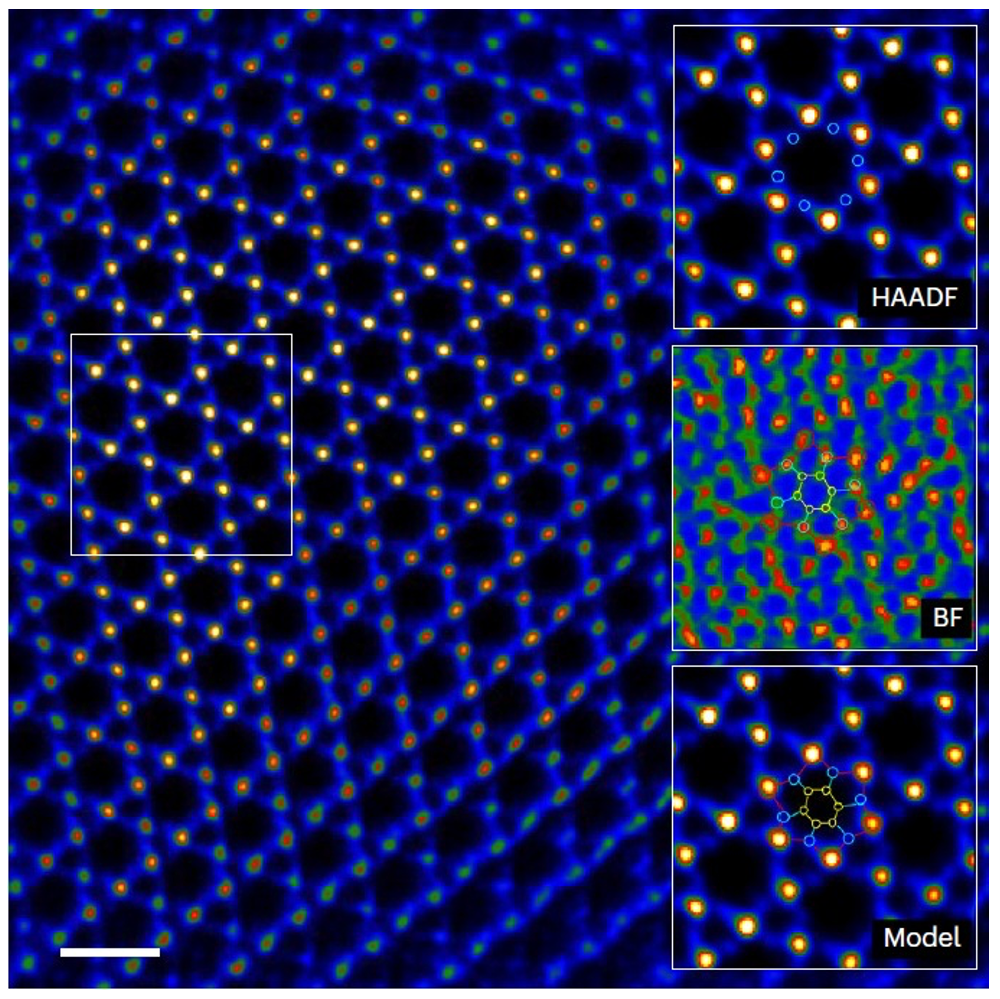
High-angle annular dark-field scanning transmission electron microscopy (Fig. 2) shows a high-symmetry, non-distorted kagome lattice formed by the copper atoms. Each BHT unit is connected to six neighbouring BHT units through shared Cu atoms, and each Cu atom coordinates with four S atoms, creating a dense hexagonal d–π conjugated plane. Combined with X-ray scattering, the microscopy images pin down the full crystal structure, as the box explains.
To investigate the microscopic charge transport, the team used TRTS, a contact-free method. An ultrashort laser pulse creates hot carriers, and a terahertz pulse that follows probes how well they conduct (see box).15 After excitation, the photoconductivity rises within less than a picosecond, showing that mobile carriers are generated almost instantly. The positive sign of this photoconductivity confirms that the Cu₃BHT films are intrinsically semiconducting.12
The photoconductivity then falls quickly within about one picosecond, followed by a component that lasts for over a nanosecond. Measurements at different excitation densities and photon energies show that the fast decay does not come from charges being trapped at defects, but from hot carriers losing their extra mobility as they cool (see box).
At low excitation densities the hot carriers cool within about 500 fs. Above about 1015 absorbed photons per cm², cooling slows to about 750 fs, a hallmark of the so-called hot phonon bottleneck. The slow energy loss is favoured by the low optical phonon energy of Cu₃BHT, around 10 meV, and its small electron–hole reduced effective mass.4 The resulting hot carrier lifetime is well above the sub-100 fs lifetimes typical of conventional organic compounds6,7 and comparable to the 200 fs to several picoseconds seen in inorganic and hybrid perovskite materials.13
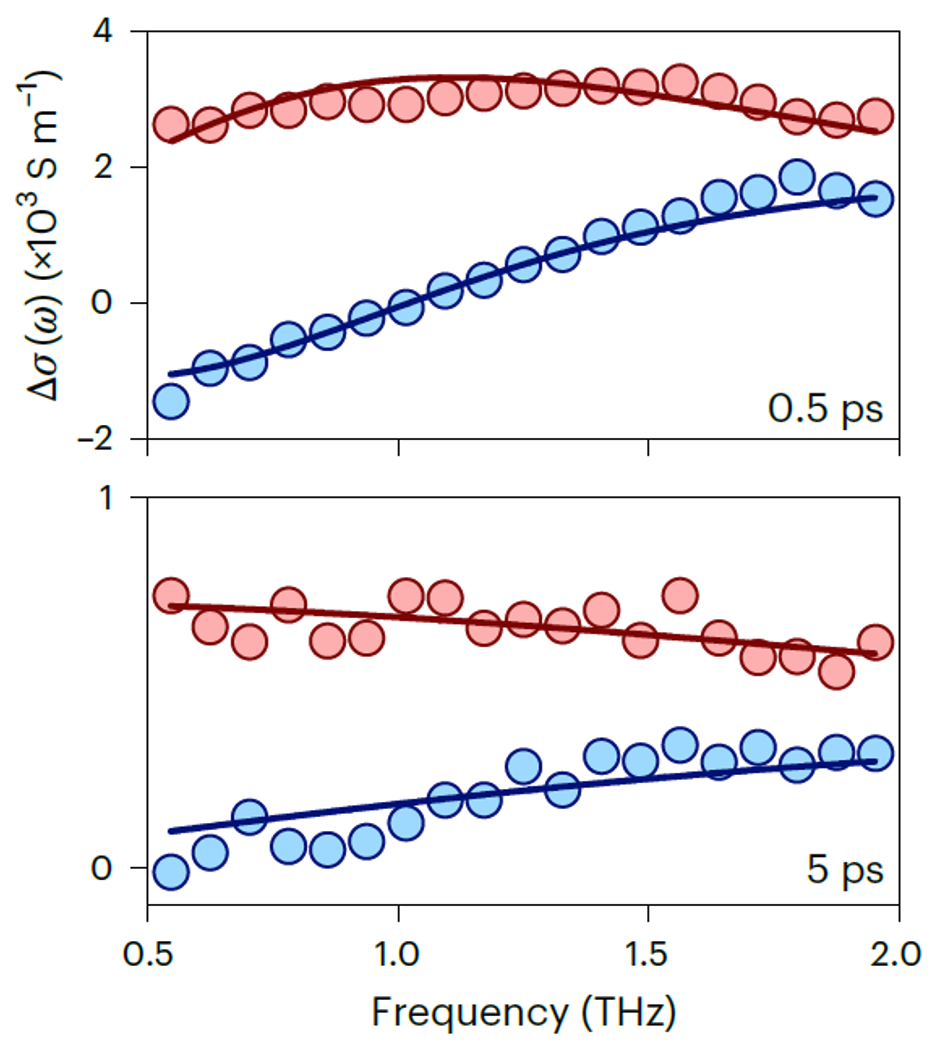
The frequency dependence of the THz photoconductivity shows the change from hot to cooled carriers directly (Fig. 3). Half a picosecond after the maximum, it follows the Drude–Smith model,18 which describes charges that are partly scattered back: hot carriers travel far enough to reach the boundaries of the roughly 100 nm grains. Five picoseconds after the maximum, the spectrum follows the simple Drude model of free charges. From the fitted scattering time of about 41 fs, the band-edge carriers reach a mobility of about 405 cm² V⁻¹ s⁻¹, and hot carriers excited at 1.55 eV about 2,000 cm² V⁻¹ s⁻¹. With the band-edge carrier lifetime of about 1.2 ns, this gives an intrinsic diffusion length of about 1.1 μm. Both mobility and diffusion length set new records for organic materials. Cooling the film from 287 K to 78 K lowers the scattering rate from about 50 to 30 THz, a hallmark of band-like transport.

Fig. 4a shows the transient absorption (TA) spectra of Cu₃BHT at various pump–probe delay times after 1.77 eV photoexcitation. They show a broad photoinduced absorption signal between 2.4 and 3.0 eV, which shifts to higher energy (blue-shift) by about 60 meV within the first few picoseconds.
The temporal evolution of this absorption band mirrors the photoconductivity dynamics, which suggests that the blue-shift is linked to hot carrier cooling.5,19 The calculated electronic band structure and density of states support this: transitions from the Cu d-band to the valence band edge can account for the observed photoinduced absorption (Fig. 4b).
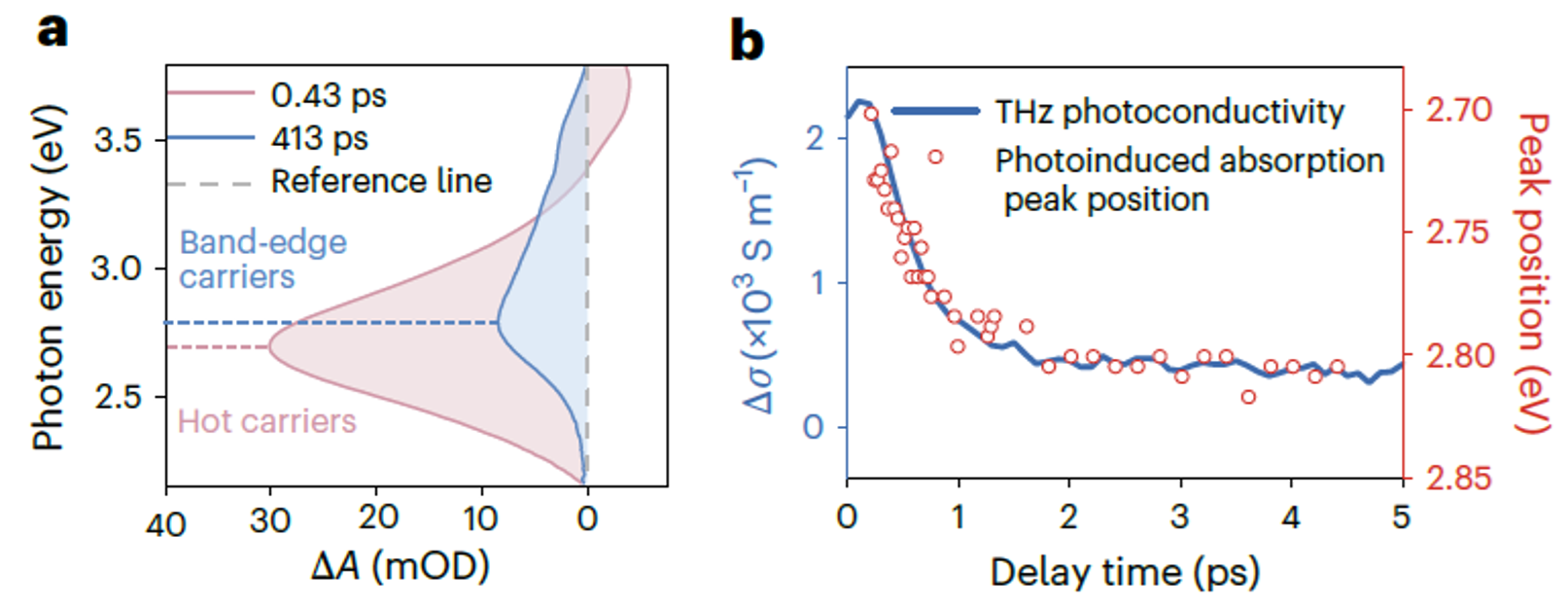
A global fitting analysis of the TA spectra identifies two distinct spectral components at 2.69 eV and 2.79 eV, assigned to hot carriers and band-edge carriers (Fig. 5a). The peak energy shift, which signals hot carrier relaxation, evolves in tandem with the photoconductivity decay (Fig. 5b). This establishes the blue-shift as a spectroscopic marker of hot carrier cooling. Transient absorption microscopy shows the same picture in real space: within the first 0.6 ps, the hot carriers spread out ultrafast and travel 200 to 320 nm, far beyond the average grain size.
The first demonstration of high-mobility non-equilibrium states in 2D c-CPs opens new possibilities for organic-based (opto-)electronics: hot electron transistors, hot carrier photovoltaics with higher voltages and currents, and plasmonic photocatalysis. With the wide chemical and structural tunability of 2D c-CPs, many further options remain to be explored through metal substitution, ligand design and guest molecules.
Resource:
Fu, S., Huang, X., Gao, G., et al. (2025).
Unveiling high-mobility hot carriers in a two-dimensional conjugated coordination polymer.
Nature Materials, 24, 1457–1464.
https://doi.org/10.1038/s41563-025-02246-2
 Download this news article as PDF – for reading on paper, taking notes or filing.
-
Paul, K. K., Kim, J.-H., & Lee, Y. H. (2021). Hot carrier photovoltaics in van der Waals heterostructures. Nature Reviews Physics, 3, 178–192. https://doi.org/10.1038/s42254-020-00272-4
-
Liu, C., et al. (2024). A hot-emitter transistor based on stimulated emission of heated carriers. Nature, 632, 782–787. https://doi.org/10.1038/s41586-024-07785-3
-
Jailaubekov, A. E., et al. (2013). Hot charge-transfer excitons set the time limit for charge separation at donor/acceptor interfaces in organic photovoltaics. Nature Materials, 12, 66–73. https://doi.org/10.1038/nmat3500
-
Fu, J., et al. (2017). Hot carrier cooling mechanisms in halide perovskites. Nature Communications, 8, 1300. https://doi.org/10.1038/s41467-017-01360-3
-
Price, M. B., et al. (2015). Hot-carrier cooling and photoinduced refractive index changes in organic–inorganic lead halide perovskites. Nature Communications, 6, 8420. https://doi.org/10.1038/ncomms9420
-
Banerji, N., Cowan, S., Vauthey, E., & Heeger, A. J. (2011). Ultrafast relaxation of the poly(3-hexylthiophene) emission spectrum. The Journal of Physical Chemistry C, 115, 9726–9739. https://doi.org/10.1021/jp1119348
-
Engel, E., Koschorreck, M., Leo, K., & Hoffmann, M. (2005). Ultrafast relaxation in quasi-one-dimensional organic molecular crystals. Physical Review Letters, 95, 157403. https://doi.org/10.1103/PhysRevLett.95.157403
-
Haldar, R., et al. (2021). Interplay of structural dynamics and electronic effects in an engineered assembly of pentacene in a metal–organic framework. Chemical Science, 12, 4477–4483. https://doi.org/10.1039/d0sc07073d
-
Dou, J.-H., et al. (2021). Atomically precise single-crystal structures of electrically conducting 2D metal–organic frameworks. Nature Materials, 20, 222–228. https://doi.org/10.1038/s41563-020-00847-7
-
Wang, M., Dong, R., & Feng, X. (2021). Two-dimensional conjugated metal–organic frameworks (2D c-MOFs): chemistry and function for MOFtronics. Chemical Society Reviews, 50, 2764–2793. https://doi.org/10.1039/D0CS01160F
-
Huang, X., et al. (2015). A two-dimensional π–d conjugated coordination polymer with extremely high electrical conductivity and ambipolar transport behaviour. Nature Communications, 6, 7408. https://doi.org/10.1038/ncomms8408
-
Huang, X., et al. (2023). Semiconducting conjugated coordination polymer with high charge mobility enabled by ‘4 + 2’ phenyl ligands. Journal of the American Chemical Society, 145, 2430–2438. https://doi.org/10.1021/jacs.2c11511
-
Lin, W., Canton, S. E., Zheng, K., & Pullerits, T. (2024). Carrier cooling in lead halide perovskites: a perspective on hot carrier solar cells. ACS Energy Letters, 9, 298–307. https://doi.org/10.1021/acsenergylett.3c02359
-
Toyoda, R., et al. (2022). Heterometallic benzenehexathiolato coordination nanosheets: periodic structure improves crystallinity and electrical conductivity. Advanced Materials, 34, 2106204. https://doi.org/10.1002/adma.202106204
-
Ulbricht, R., Hendry, E., Shan, J., Heinz, T. F., & Bonn, M. (2011). Carrier dynamics in semiconductors studied with time-resolved terahertz spectroscopy. Reviews of Modern Physics, 83, 543–586. https://doi.org/10.1103/RevModPhys.83.543
-
Uhd Jepsen, P., et al. (2001). Ultrafast carrier trapping in microcrystalline silicon observed in optical pump–terahertz probe measurements. Applied Physics Letters, 79, 1291–1293. https://doi.org/10.1063/1.1394953
-
Zhang, H., et al. (2021). Highly mobile hot holes in Cs2AgBiBr6 double perovskite. Science Advances, 7, eabj9066. https://doi.org/10.1126/sciadv.abj9066
-
Smith, N. V. (2001). Classical generalization of the Drude formula for the optical conductivity. Physical Review B, 64, 155106. https://doi.org/10.1103/PhysRevB.64.155106
-
Lim, J. W. M., et al. (2020). Hot carriers in halide perovskites: how hot truly? The Journal of Physical Chemistry Letters, 11, 2743–2750. https://doi.org/10.1021/acs.jpclett.0c00504